Monday, July 7, 2014

Slackers, Hipsters and the Loss of Emptiness

-->

Slackers and Hipsters
I was thinking back to the days when Williamsburg was slacker central (the early 90’s?).
Back then the L Cafe anchored slacker central and I would sandwich there.[1] Service always took forever so one day I called ahead to order, but no one answered the phone. Strolling over to Bedford I was surprised to find them open. When I told the slacker behind the counter that I had called several times she turned to her "coworker" and said "have you noticed that the phone has not rung a single time today"? To which the response was "excellent".
The sandwich took 20 minutes.
There weren't many places to eat at back then.


Campbell Cheese & Grocery
Yes the 11211 area code is now overrun with hipsters but the interesting thing about hipsters is that they are an unusually gifted group of entrepreneurs. Some such individuals recently opened a corner grocery store near me. A corner grocery store? Yes, Campbell Cheese & Grocery is not a deli, but a true corner grocery where quality staples can be found just a short walk away. Of course the cost of these staples far surpasses any convenience. After all these are artisanal, hipster staples: organic produce, craft beers, etc. Low cost is not part of a hipster grocery store. Graduate degrees seem to be though.


Park Luncheonette
There used to be an old school corner luncheonette near McCarren Park. It closed and somebody fixed up the place to "look like" an actual old school luncheonette, spending a tidy sum installing new “old” details that were never part of the original luncheonette. It looks like a hipster joint, however a recent visit to Park Luncheonette revealed that they are in fact casually resurrecting slacker central.
Pizza, burgers, beer, wine and fine spirits are among the offerings. I sat at the counter and ordered a burger (medium) and a Coke. Soda came first. It tasted off so I asked the bartender if it was Coke. He replied, “it’s cola” in a manner that suggested “isn’t that close enough”. I requested a seltzer.
The place had a staff that seemed like they had either not slept the night before or slept in their clothing (nothing wrong with that, I’m just saying). There were several individuals who seemed to be intimate with the place, but were not doing anything productive. One of the female intimates walked over with a burger on a plate, not really knowing what to do with it she offered it to the barkeep. He asked if it was a medium burger. She shrugged her shoulder as if to imply “don’t know, not my job” and handed it to him. He gave it to me in his “close enough” manner. The plate also had the salad I ordered, so I agreed, close enough. And it turned out to be just that.
Clearly, this was not a fully functional hipster joint; perhaps it’s in the beta launch phase.[2] I suspect it’s a revival of the slacker cafe, proudly foreshadowing a reincarnated slacker central.


The Loss of Emptiness
It seems like a million people move to NYC every year. There used to be such a thing as emptiness, even in Manhattan. Empty lots, empty buildings, empty spaces. Grand Central, Lincoln Center, Times Square, the East Village, all had vast spaces where one could wander about, and simply take it all in. Nocturnal wonders full of nothingness. Truly public spaces, undefined, unregulated and sometimes scary.

I lived in Times Square during the 80s and would seek out these places and their emptiness.
And Times Square, that lovely black hole, had its own quiet, dark and gloriously underused crevasses. Now filled with the masses, and restaurants, it has lost its uselessness.

Grand Central before it was "renovated" had fantastic, uninhabited balconies, public spaces that one could freely access and linger about. Unbothered by any sense of purpose. Now occupied by restaurants the purposelessness of these spaces is gone.

Lincoln Center, that bustling center of culture, had a marvelous, underused, wide travertine pedestrian bridge silently sitting there, open to possibilities. After a recent rehab it was removed. Of course there’s a restaurant now and in a nod to openness they’ve provided a small sloping green lawn that desperately wants someone to lie on it. Set off to the side is a spindly footbridge, ignored and equally desperate looking it would very much appreciate some foot traffic.


Upstate Alert!
The Susan Hartung exhibition is coming together. This 50 year survey of drawings and paintings will be at Hudson Valley Community College in Troy, NY.
Exhibition dates: September 18 - October 25.
Opening reception: Thursday Sept 18, 4-6pm.
Spread the word.


[1] Yes, sandwich is now a verb.
[2] In addition to the use of sandwich as a verb, I have also seen the Beta Launch concept applied to the non-tech world where an enterprise is launched functional, but not quite finished (close enough), and is tweaked according to customer feedback. Or not.

Wednesday, April 30, 2014

A Stroll Down Park Avenue and the Erasure of Josef Albers

A Stroll Down Park Avenue.
This semester my Intro to Art class has followed the Richard Prince case and debated the whole idea of artists using other people’s images in their work. Conveniently, both Richard Prince and Andy Warhol have shows up. First we went to see the Warhol paintings of Jackie Kennedy at Blain/DiDonna. The students felt that through the silkscreen process Warhol had transformed the images he worked with, and was therefore justified in using them. With Prince (across the avenue at Gagosian) they were less than enthusiastic and simply didn’t think the work merited any attention. We went over ideas related to appropriation and context but they feigned a total lack of interest. I told them that with a couple more years of art school they’d be on board. They doubted it.

In the same Gagosian location there is an interesting selection of Ed Ruscha paintings on view and while there I was reminded that there’s a new Gagosian space on 75th & Park Ave. It’s called Park & 75 and has an Urs Fischer show. That guy has been busy. I don’t always pay a lot of attention to the artist-as-provocateur pack, but he seems to be the leader of it (of course Sarah Lucas, and others, might dispute that). 
Working ideas that most artists have had or have, Fischer torques them and pushes them to extremes while using a blatant “in your face” approach (the hole in the gallery floor, the melting figures, the reproduction of the wall placed on the wall being reproduced, etc.). At Park 75 he has a large piece. It’s a cast metal sculpture that was made from a collaborative process with a whole lot of people (kids included). 
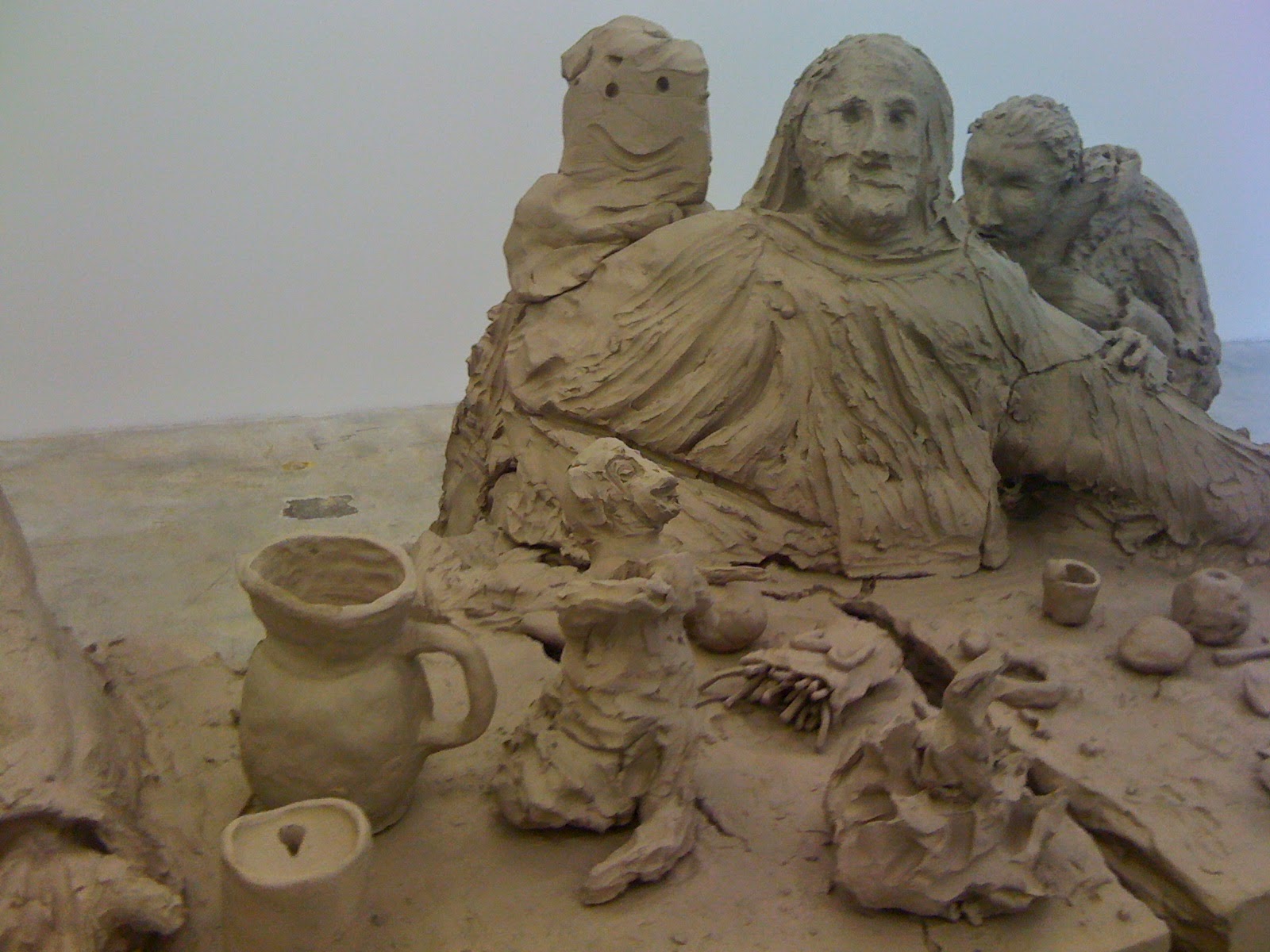
It’s a roughly modeled send up of the Last Supper where the figures eat hot dogs, drink beer, grab each others’ asses and, in general, engage in horseplay and convivial debauchery. Gotta love his energy and free spirit. Maybe.


Walking south down Park Ave I came upon a series of Alice Aycock sculptures. When I was a student and she was an emerging artist I followed her work and that of her contemporaries: Charles Simonds, Mary Miss, George Trakis, Gordon Matta-Clark, etc. They were the generation that came after the Earthworks artists, but they didn’t need to go way out into the desert with bulldozers and dump trucks to make their work. They could simply go to the end of a parking lot with string and wooden stakes and make a piece. They could go up to the Bronx with a chainsaw and cut out shapes in abandoned buildings, or walk around the lower eastside with a bag of wet clay and pre-made miniature bricks improvising cliff dwellings on the craggily surfaces of dilapidated buildings. They could make work in Jersey that mattered. That was when an alternative scene had emerged that was equal but different then the gallery world, or so it seemed at the time. Aycock’s aluminum swirls on Park Ave are a world away from those days.


Continuing south, on the way to another Warhol show, I discovered another Fischer show. That guy seems to be at a point in his career where he has the ability to make anything he can think up. In the Lever Building he has mirrored boxes with printed images of objects on them. A kind of Pop Art/Minimal Art fusion. Didn’t Warhol do that?  


The Erasure of Josef Albers.
There is an Andy Warhol exhibit of Polaroids in the hallway of 717 5th Ave, just past the reception desk. Behind the reception desk is a large gold leaf Josef Albers mural that is routed into the marble wall. 


The Warhol portraits are minor (though Tatum O’Neal is cute) but the Albers mural is a major work. Restored in the early 90’s with real gold leaf (the original used a cheaper substitute) it is one of only two that remain in midtown. The other one is in the Time-Life Building.
At one time Albers had four murals in midtown. Perhaps his most prominent, but often unnoticed, was in the old Pan Am building (now the Met Life building). Tightly installed over the escalators that descended into Grand Central, it was taken down when they redid the lobby in 2001.
His most visible mural was in another building on 6th Ave. It was a large drawing done with red & white tile that was visible from the street. But that was also lost to a lobby redo. 


Monday, April 21, 2014

Relationships, Rituals, Addictions and Other Musings

The New Abnormal

During my first semester in NY I lived in a shabby hotel in Brooklyn Heights (the one where Travis Bickel bought a gun in Taxi Driver). I kept a hammer near my bed. Every morning at 3am my neighbor would blast a religious radio station. I’d bang on the baseboard a few times and he’d turn it down. It was a working relationship.
At the time I was a student at the School of Visual Arts. On Thursdays I’d walk across the Brooklyn Bridge into Manhattan, eat lunch in Chinatown, see galleries in SoHo and arrive at SVA in time for my 4pm class with Carter Ratcliff. It was a ritual.
Carter was a quiet, low talker kind of guy so I always made sure to sit in the front row. One day I fell asleep in class, head on desk. I awoke to find Carter pacing back and forth across the room, seemly holding a conversation with himself. Embarrassed, I groggily turned around to check on my classmates. All were sound asleep, heads firmly planted on their desks. Carter kept on talking, pacing back and forth.
In those days a classroom full of sleeping students might have been the ultimate nightmare for instructors, especially in a small classroom. Now it’s texting. No one sleeps anymore, they’re too busy texting. It’s an addiction.

Sometimes I teach in a classroom, sometimes a sculpture studio. The studio can be abuzz with materials being cut, noise levels high, yet students, standing near a band saw, or dangerously close to some other tool actively being used, will be texting, oblivious to their surroundings. Safety anyone?
In classrooms students are often texting as a discussion is in progress. What goes on here? Is this the new abnormal? Not long ago there seemed to be a concern about attention deficit, now it’s attention elsewhere.
In casual conversations with other instructors they all reported similar experiences. I eventually decided I had to tell students that I was considering counting texting in class as being absent. Remarkably everyone said that it would be a fair thing to do and acknowledged that if someone is texting, then clearly that person is not present and therefore absent. What? Were they admitting to their addiction? Was this a cry for help?

This semester I’m teaching at Haverford College. No texting issues there. It was formed by Quakers and has an honor system that students abide by. Somehow cell phones don’t rule their classroom lives. It’s true, miracles do happen.
Through Haverford’s Distinguished Visitors Program, I was able to invite the architect Jonathan Kirschenfeld to visit the campus and talk about his work in designing “supportive housing” and why he founded The Institute for Public Architecture. http://instituteforpublicarchitecture.org/

Jonathan gave a great overview of the history behind “supportive housing”, his work, and the efforts of the IPA. It’s a multi-purpose think tank, residency program for architects that advocates for new approaches to public housing. The IPA organized the recent event: “Roundtable: A Total reset for Public Housing”. Check it out.


Other musings:
Although Film Forum provides consistently great programming it’s not really a great place to see films. Small, tightly fit seats with no legroom in narrow quarters and small screens. It has the unfortunate feel of a miniature 1980’s multiplex. I went there recently to see Jodorowsky’s Dune, a colorful and fascinating documentary of his efforts to make a movie about Frank Herbert’s book Dune. Although he failed to make the film, his well-known efforts to do so influenced many future sci-fi films.
Throughout the documentary Jodorowsky is shown to be a man of passion. Conceptually he envisioned his approach to filming Dune as “raping Frank Herbert, but…with love”.
Yes, he’s a man of passion.


Ida, a great Polish film I wrote about in a previous post, will be playing at Film Forum in May. It’s a starkly beautiful film in which black & white cinematography, austere means and extraordinary acting combine to confront a dark and difficult subject matter. As with most Polish films, no happy ending required. Can’t get any better.


Upstate Alert!
I’m putting together a survey exhibition of drawings and paintings by Susan Hartung. In the fall it’ll be at Hudson Valley Community College in Troy, NY. Spread the word.


PS. The Corcoran Gallery of Art in Washington, D.C. is closing and dispersing their collection.
How about remaking the building into a factory or mill, thereby reversing the trend of turning former industrial spaces into museums?


Monday, March 10, 2014

The New York Art World is So Much Fun.

Or maybe I think that because I didn’t go to any art fairs.

Spent an afternoon seeing several exhibits.
Even though 90% percent of all art sucks (my students say 99%) there’s always at least one great show out there.

Hauser & Wirth has Selections from the Onnasch Collection on view. It felt like I had walked into a wing of the Museum of Modern Art. Perhaps instead of knocking down buildings in midtown the Modern should consider simply buying exhibits, building and all, and make them satellite branches of the museum. Since galleries put on museum quality shows on a regular basis these days (like the recent exhibits by Richard Serra) this approach could help facilitate museum expansions, even by museums from out of town.
In H&W there was room after room of classic hits. First, a room with paintings by Newman, Still, Noland and Louis. Then one with work by Twombly, Rivers, David Smith, Motherwell and Kline. Followed by Rauschenberg, Dine and Segal. Leave that room and there’s one dedicated to Oldenburg. That leads to one dedicated to some Tuttles. How great is that? Tuttle is always best when it looks like he spent about $25 on materials for the entire show. He spent even less here.
There’s a Dieter Roth (although at first I mistook it for an Arman, I guess that was part of the joke), a bunch of dusty Kienholtz’s, a couple of cool sculptures by George Brecht and a delicate balance of tonnage by Serra (remember when people hated him for creating aggressive anxiety causing pieces, especially his bigger ones? That was before he produced the elegant ribbons of enclosed space that he is now lauded for. We love him).
The great thing was that H&W didn’t have any of those annoying museum guards in each corner, just a couple of young people here and there keeping an eye on things.
Before I left I again thought of having a drink at their bar, but they still don’t have a restroom.
511 West 18 Street. Through April 12.

Postscript: Hauser & Wirth.
When I got home I mentioned to my wife that H&W had a greatest hits show of postwar American art. And she said, oh, you mean like Helen Frankenthaler? No. Louise Bourgeois? No. Eva Hesse? No. Any women artists? No, but it was a great show.


Rudolf Stingel had several big paintings at Gagosian. They were of mountains. Some looked like he had laid them on the floor after he painted them, where they then functioned like tarps, collecting drips of paint while he painted the other canvases. I had the impression that the drips were smeared by Stingel while pacing about. Thus the smudges and random markings reinforced the idea that Stingel worked on his paintings. Or at least that’s what it looked like.
The concrete floor of the gallery was remarkably polished and unscarred considering that Serra had recently planted tons of steel on it.
522 West 21 Street. Through April 19.


I then went next door to Barbara Gladstone. She also had a perfectly polished concrete floor, absolutely identical to Gagosian’s. Maybe there was a two for one deal. I’ll have to look into that.


Peter Buggenhout had a couple of funky and dusty industrial heaps in the space. It was as if the early funk-meister sculptures of Bruce Connor went gigantic and heavy metal. Although these dirty accretions appeared strong, and dense, parts of them were actually fragile. I touched them. There were no guards there.
530 West 21 Street. Through April 19.


Spoiler Alert (I love the Work of Diana Al-Hadid).


Boesky’s uptown space is a seemly unaltered, very narrow, townhouse that consistently houses must see exhibits on a quiet upper eastside block.
Al-Hadid is in the house with a great selection of freestanding and wall mounted sculptures. Fragile looking beyond belief, they are large, fragmented, figurative, raw and architectural at the same time. Associations run in all directions but she tries to anchor the show by including a bronze sculpture by Medardo Rosso. Although it was a nice touch I didn’t think it was really necessary. The show’s title says it all: Diana Al-Hadid: Regarding Medardo Rosso.
118 East 64th Street. Through March 19.


______________________________________________


Polish Movies, or No Happy Ending Required.

Went to a spate of Polish films recently. One series was at the Walter Reade Theater (love that theater), another at BAM (love that theater a little less). I have always been interested in the work of directors who came out of the Lodz Film Academy, but also Polish filmmakers in general. And the last 100 years of Poland’s history has certainly provided them with an endless source of material. Re-examining pre, post and war, ridden Poland, and all that entails, is certainly a monumental challenge. No happy ending required.
For example, last year I saw In Darkness, a recent film by Agnieszka Holland (she also directed a few episodes of The Killing, highly recommended and available on Netflix).
Darkness was a great film based on real events that occurred during World War II. In it Leopold Socha is a Polish sewer worker who helps save a group of Polish Jews during the war by hiding and caring for them in the sewer system for fourteen months. Grim conditions for sure, but at the end of the war they emerge triumphantly filthy, glad to be alive. Happy ending? Yes, that is until the credits reveal that Leopold was run over by a truck and killed a short time after saving the Jews. It was a great film.


At Walter Reade: Martin Scorsese Presents: Masterpieces of Polish Cinema.

I saw three films:

Camouflage: a mind fuck of a film about academia that could also be used as a rallying cry against tenure.


The Hourglass Sanatorium: based on the writings of Bruno Schulz, it was a delirious, trippy, Through the Looking Glass, never ending, tale in which at times it was impossible to tell what was a movie set and what was real. All of it would have appealed to Ed Kienholtz.


Blind Chance: a film that had three sections, each based on whether or not a young man catches a train on time. He often doesn’t and thus is pulled into the politics of the day. No happy ending required.


At BAM: Kino Polska: New Polish Cinema

I saw two films:

Ida: set in the 1960s, Ida is an orphan raised in a convent. On the verge of becoming a nun she discovers that she is Jewish. She reconnects with an aunt who helps Ida discover how her family was inexplicably murdered during the war. They were being sheltered and hidden from the Nazis, but things went bad before the Nazis could find them (trying to not give too much away here). Ida returns to the convent.

A beautifully shot and acted bummer of a movie. It was great.


Papusza: another black & white beauty/bummer of a film. This one is based on a true story about Bronislawa Wajs, the Roma poet known as Papusza. Most of the actors are non-actors and gypsies. They give an insightful look at Roma life before, during and after the wars. Fantastic characters. Another film with locations that often seemed unreal, but probably were real. It dazzles, and leaves you feeling very sad. But if I ever have a daughter I’ll name her Papusza.

All of these films added insightful moments in a casual and straightforward manner. Like when Leopold is at home after a day spent in the sewers. He’s having a relaxing conversation with his wife as she finishes the last of the dirty dishes, which were soaking in a large tub. As she pulls the last dish out Leopold strips down and gets into the tub to bathe. Same tub. Same water.

There were many other Polish films at both locations that I did not get the chance to see. Gritty, somber, realistic, surreal, beautiful films. Next time for sure.

Saturday, January 25, 2014

Ana and Steve at Ventana 244 have done something quietly remarkable.


The Real Estate Show

 
 Over the past couple of years Ana and Steve have been inviting artists to collaboratively use their storefront space. The first installment was a gathering orchestrated by Dan Walsh. Since then there have been many such incarnations (I collaborated on one last year) and currently there is a massive in-progress/partnership coordinated by Peter Soriano and Philippe Richard entitled Real Estate, an ever-evolving installation, loosely inspired by Kurt Schwitter's Merzbau. At Ventana, through a conceptual twist their Merzbau explores the tension between artists and real-estate developers.  

Soriano and Richard put together an initial working group of artists to take on the various roles of property developer, architect, general contractor, and branding specialist: all the trappings of current high-end development.

 Once they had established their identities and transformed the ground floor space an “Open House” was held on January 24th. This unveiling, with the attendant-overflowing crowd, was more than an “opening”; it was an art world simulation of the Williamsburg condo buying frenzy.

People lined up and packed the inside.

There will be a second phase to this confabulation. A new group of artists, who in the roles of tenants and sub-tenants, will renovate, expand, demolish, and/or subdivide the space. During the run of the exhibit an artist, in the role of a displaced tenant, will stage an independent, parallel exhibition outside the gallery.

Some of the participants:
Peter Soriano, Philippe Richard, Alisdair Duncan, Ward Shelley, Edouard Prulhiere, Sylvie Ruaulx, Bruce Pearson, Tamas Veszi, Olivier Soulerin, Raphaele Shirley, Eve Bailey, Jay Shinn, Kate Shepherd, Michael Scott, Daniela Kostova, Joro-Boro, Milena Deleva, Mario Mohan, Vlada Tomova, Georgi + Nina Tushev (Tushevs Aerials), Meglena Zapreva, Meglena Zapreva, Frederique Lucien, Agnes Barley, Dominique De Beir, Miguel Angel Molina, Pierre Mabille, Michelle Antoine, Kevin Walsh, Jenny Polak, Matt Bua, Peter Dudek, Irina Arnaut, Laurel Sparks, Chris Moss.


Saturday, January 18, 2014

Does Art Have to Pee Everywhere?

Art often takes over underused or abandoned industrial spaces. Making or experiencing art in places that have little or no previous art history provides a different context. Uncharted terrain and raw spaces, perfect fits for contemporary art. DIA Beacon took over a former box printing factory, MassMoca a former electronics plant and textile mill. Both in towns that have seen better days and are experiencing economic upticks because of their presence.
I grew up in a town that had no museum, no galleries. It was an art free zone. One had to imagine the art, for it was not there to be seen. When I went away to school it was always refreshing to return home, to be in that neutral zone, a no art district. But that has been changing. Artists seem to be everywhere now, and that means art. There’s no avoiding it. For example to showcase how art is coming to the rescue of Detroit (and propelling the city’s any-day-now comeback), its annual auto show is hosting an event in an artist live/work building that used to be a factory. Yes, culture has the capacity to transform urban environments (check out yet another article in The Times about Hudson) but does art have to pee everywhere?
Creative Time has plans for the Domino Sugar Plant!


The Domino Sugar Plant is slated to be razed. But while it still stands on the Brooklyn waterfront, Creative Time has decided to commission art works for this gigantic former sugar shack.
One would love to visit this space open, unlocked and unadorned. To wander about. Day and night. In a cavernous no art zone.
But, then again, maybe that would be art as well. Funny how wandering about is art these days.


The Great Beauty and American Hustle


The Great Beauty:
It chronicles the days, but mostly nights, of an Italian writer, at home in Rome who instead of working on his next book gets caught up in a decades long party vortex with the accompanying nightlife miasma of good suits and debauchery. Of course the leading man, Toni Servillo, has a great party puss. And I guess an updated Fellini-esque film of Rome was overdue. But how did that stripper die? Midway through the movie the plot seemed ready to shift gears when she and Servillo meet, and then, poof! She’s gone. Dead. One suspects things will soon start to go south but by the time things really get bitingly cruel the fact that the film is running 30 minutes too long has long set in.
Was this a comedy? A satire? In a well-populated theater my wife seemed to be the only person who really laughed (once), although I’m sure many smirked now and then at the absurd antics and posturing of a people spinning their acculturated wheels and banging their heads (literally), against the stoic beauty of Rome.

While watching this movie I couldn’t help but think that if it was about an American writer, instead of an Italian, who had published a successful novel in the 60s and then moved to Rome with hopes that this ancient city would stir his creative juices… that could be an interesting and complex film. The actor of choice would be Christian Bale who in American Hustle transforms himself into an unrecognizably corpulent con artist. This Scorsese-esque comedy features a bunch of good ol’ boys in a laugh-out-loud entrapment farce.  All the actors are beauts. But the movie hinges on Bale, the hustler supreme. And Bale as an expat writer? Supine and adrift, his creativity unmoored by the giddy decadence of Roman vices. Now, that’s a creative thread I’d like to follow.

Thursday, January 9, 2014

Motherwell Collages & Chris Wool

Perhaps because I’m very much interested in the hands-on, low-tech sort of things nowadays, I went to the Guggenheim to see the Motherwell collages & Chris Wool paintings.

Motherwell.
His significance over the years seems to have diminished; a few have even spoken of him as a lesser Ab Exer. But in the 1970s he certainly could draw a crowd. I saw him speak at the School of Visual Arts (1977?). He had established some cache on the political spectrum of painting primarily because of his “Elegy” series. When asked about them he recalled: “at the time there was a feeling that evil could take over the world”. These days it seems like there are multiple evils hovering about, but on that evening the singular weight of his statement, simple as it was, filled the space with a profound silence. Later asked to further explain some of his work he said to much applause: “if I wanted to use words I’d be a writer”.  Of course he was well read and quite articulate (see Painters Painting), when he chose to be.
Not a large show this. And not just collages either. A couple of sweet paintings and drawings are included in this selection of rarely seen works.  Although there might be touches of Matisse, Picasso or Arp here and there, it’s the connections to his contemporaries that got me.  It wasn’t his working through Surrealism and Cubism; it was his dialog with Gorky and David Smith. It was a painting in homage to John Cage. It was the evocation of the years when American abstract painters were starting conversations with each other rather than looking over their shoulders at the Moderns in Paris.
This was an open notebook sort of show, full of experimentation. Shapes and textures that would come into play in future works scurried about.

Works from the 1940s


Wool.
I always felt that he and Phillip Taaffe were large-scale printmakers, not painters really.  Nonetheless here was his work spiraling down the Guggy, which is a difficult space for large flat artworks. I remember a Noland retrospective where his wide horizontal paintings seemed to visually warp because of the curvatures behind them. Wool doesn’t have that problem. His verticals hover in front of the viewer, bathed in a light unique to the Guggy. Cantilevered off the curved walls by flying buttresses attached to their rears, a space is created behind the works that is an exhibition in and of itself.
His jokey word paintings aside, looking at his small noirish photographs made me wish that Wool’s early work had visually darker manifestations. Black on black perhaps. Instead he was content with an obdurate, simplistic black on white technique. Later on his work did become much more painterly in a “Goodbye to All That” sort of way. Wiping away imagery with solvent soaked rags. Layering and muddying up the imagery. And in one of the rectangular rooms, a group of four paintings suddenly suggested a Rothko Chapel moment of their own. Now that’s a painter.

Hovering in Space

The Flying Buttress

The Space behind a wall, behind a painting


People.
Since these were not blockbuster exhibits why all the people? Museums are quite full these days. All museums should be open 7 days a week. No? And at least one day a month for 24 hours straight. Yes!
Otherwise we’ll never again have that feeling of being alone with a body of work.
There was also a small Kandinsky show at the Guggenheim. It merited much more time than I could give it. The room was simply way too crowded.